What Are Peptides?
A clear guide to peptide structure, amino acids, peptide bonds, biological function, and scientific research.
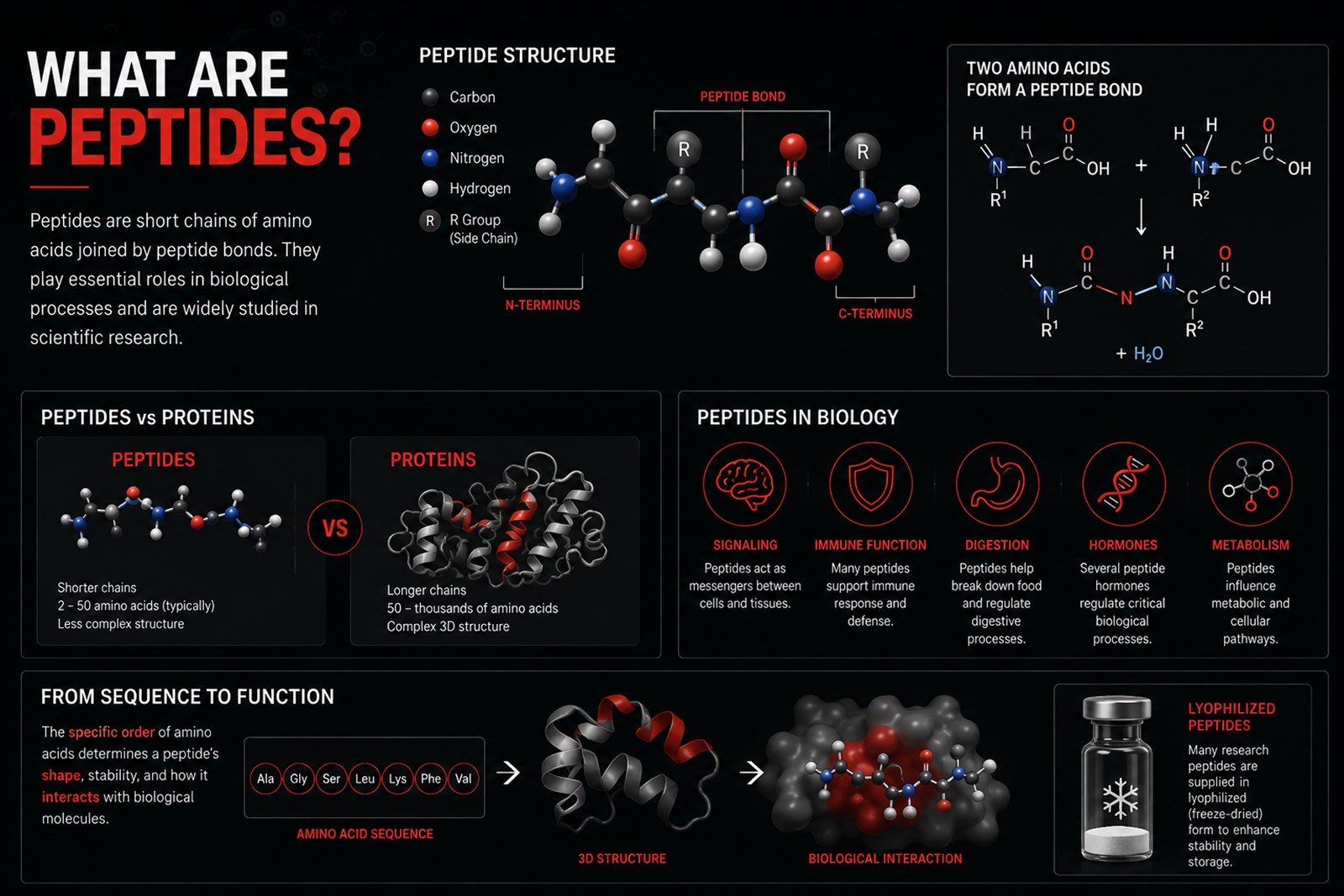
Peptides at a glance
Peptides are small chains of amino acids found throughout biology. They take part in processes ranging from cellular communication and hormone signalling to immune activity and metabolism.
Because peptides can have highly specific structures and biological functions, they are also widely studied in biochemistry, molecular biology and pharmaceutical research.
But what exactly makes something a peptide? How are peptides different from proteins? And why does the order of their amino acids matter?
This guide covers the fundamentals in straightforward terms.
What Is a Peptide?
A peptide is a chain of amino acids connected by chemical bonds called peptide bonds.
Amino acids are small organic molecules that serve as the building blocks of both peptides and proteins. When amino acids connect together, they form a sequence.
A very short chain may contain only a few amino acids. Longer chains can contain dozens or more.
You may also encounter terms such as:
- Dipeptide — two amino acids joined together.
- Tripeptide — three amino acids.
- Oligopeptide — a relatively short amino-acid chain.
- Polypeptide — a longer chain of amino acids.
The terminology is useful, but biology does not provide a single exact number at which a peptide suddenly becomes a protein.
Peptides and Proteins: What Is the Difference?
Peptides and proteins are closely related because both are constructed from amino acids.
The main differences are generally size and structural complexity.
Peptides tend to contain shorter amino-acid chains. Proteins are usually larger and often fold into complex three-dimensional structures that are essential to their biological function.
There is no universally accepted cutoff separating a peptide from a protein, so it is more accurate to think of them as related categories along a spectrum.
A relatively short amino-acid chain may be described as a peptide, while a much larger, highly folded molecule would normally be called a protein.
Amino Acids: The Building Blocks of Peptides
Understanding peptides begins with amino acids.
Every amino acid has a common basic chemical structure, but each also contains a distinctive side chain. This side chain gives an amino acid many of its individual chemical properties.
Some amino-acid side chains carry electrical charges. Others interact strongly with water or avoid it. Some are relatively small, while others contain larger ring structures.
These differences matter because the combination and order of amino acids can affect a peptide’s:
- Shape
- Electrical charge
- Solubility
- Stability
- Interactions with other molecules
- Biological activity
This means two peptides of the same length can behave completely differently if their amino-acid sequences are different.
What Is a Peptide Bond?
A peptide bond is the chemical connection that joins one amino acid to another.
During formation of the bond, the carboxyl group of one amino acid becomes linked to the amino group of another. Repeating this process produces the backbone of a peptide chain.
Peptide sequences also have direction.
One end is known as the N-terminus, while the opposite end is called the C-terminus.
By convention, scientists generally write peptide sequences beginning at the N-terminus and moving toward the C-terminus.
This provides a standardized way of describing the exact order of amino acids in a peptide.
Why Peptide Sequence Matters
The sequence of a peptide is one of its defining characteristics.
Consider amino acids as letters in a molecular alphabet. Changing the order of those letters changes the resulting message.
Likewise, changing even one amino acid within a peptide can sometimes alter its structure or the way it interacts with another molecule.
A sequence can influence:
- Molecular shape
- Receptor interactions
- Enzyme recognition
- Stability
- Solubility
- Chemical behaviour
This relationship between molecular structure and biological function is a major reason peptides are useful research tools.
Researchers can compare related peptide sequences and examine how specific structural changes influence their behaviour.
How Do Peptides Function in Biology?
Peptides occur naturally throughout living organisms and perform many different roles.
Some act as signalling molecules, carrying information between cells or tissues.
A signalling peptide may interact with a receptor located on the surface of a cell. That interaction can trigger a series of biochemical events within the cell.
Other peptides can participate in immune responses, nervous-system communication, digestion, cellular regulation and many additional biological processes.
Importantly, there is no single biological function shared by all peptides.
The word peptide describes a structural category rather than one particular biological activity.
Natural Peptides
Many peptides are naturally produced by plants, animals, microorganisms and the human body.
Some function as hormones or signalling molecules. Others participate in defence mechanisms or cellular regulation.
Natural peptides are usually produced through tightly controlled biological processes in which genetic information ultimately determines the amino-acid sequence that is assembled.
Their roles vary enormously depending on their structure.
For this reason, statements about the effects or properties of “peptides” in general are usually too broad to be scientifically useful.
Each peptide needs to be considered individually.
Synthetic Peptides
Peptides can also be produced artificially for scientific research.
In peptide synthesis, amino acids are assembled in a predetermined sequence to create a specific molecule.
One commonly used laboratory approach is solid-phase peptide synthesis, in which a growing peptide chain is assembled while attached to a solid support.
Synthetic peptide production allows researchers to create precise sequences and investigate how structural changes affect molecular behaviour.
It can also allow naturally occurring sequences to be reproduced without having to isolate them directly from biological tissues.
Modified Peptides
Researchers sometimes deliberately modify peptide structures.
A modification may involve changing an amino acid, altering one end of the peptide, attaching another chemical group or making another controlled change to the molecule.
These changes can alter characteristics such as:
- Stability
- Solubility
- Molecular recognition
- Resistance to degradation
- Interaction with receptors or enzymes
Studying modified peptides can help researchers better understand the relationship between molecular structure and function.
A modified peptide should not automatically be considered equivalent to the naturally occurring sequence from which it was derived.
Even relatively small structural changes can produce meaningful differences.
Why Are Peptides Important in Research?
Peptides occupy an interesting position between very small molecules and much larger proteins.
They can be complex enough to interact selectively with biological systems while still being sufficiently defined for detailed laboratory study.
Peptide research occurs in areas including:
- Biochemistry — investigating molecular interactions and chemical properties.
- Cell biology — examining signalling pathways and cellular responses.
- Molecular biology — studying biological mechanisms and regulation.
- Structural biology — investigating how molecular structure relates to function.
- Pharmaceutical research — exploring compounds and biological pathways that may have future scientific or therapeutic relevance.
- Analytical chemistry — characterizing peptide composition, stability and other measurable properties.
Research interest in a peptide does not necessarily mean that the compound has an established medical application. Many peptides remain experimental research materials.
Peptides as Signalling Molecules
One particularly important area of peptide biology involves cell signalling.
Cells need ways to communicate with one another. In some systems, peptides act as chemical messengers.
A signalling peptide may bind to a particular receptor, often located on the surface of a cell.
The receptor recognizes certain molecular characteristics of the peptide. When binding occurs, the receptor may initiate a biochemical signalling pathway inside the cell.
This interaction is sometimes described using a lock-and-key analogy, although real molecular interactions are more flexible and complicated than a rigid lock and key.
The important point is that molecular structure affects molecular recognition.
A peptide’s sequence and three-dimensional arrangement can therefore strongly influence which molecules it interacts with.
Why Peptide Shape Matters
A peptide is not simply a straight string of amino acids.
Once assembled, the chain can bend, rotate and adopt particular three-dimensional arrangements.
Chemical interactions between different parts of the molecule influence these shapes.
The resulting structure can affect whether the peptide can interact with a receptor, enzyme or another biological molecule.
This is another reason that sequence and structure are closely connected.
Changing a single amino acid may sometimes change how part of the peptide folds or interacts with its surroundings.
Peptide Stability and Degradation
Peptides are chemical molecules and therefore can change or degrade over time.
Several environmental factors may influence stability, including:
- Temperature
- Moisture
- Light
- Oxygen
- pH
- Chemical environment
Peptides may also be affected by enzymes known as proteases or peptidases, which can break peptide bonds.
Different peptide sequences can have very different stability characteristics.
For that reason, there is no single storage rule or expected stability profile that applies to every peptide. Those properties need to be evaluated for the specific molecule in question.
What Does Lyophilized Mean?
Peptides used in laboratory research are sometimes supplied in lyophilized form.
Lyophilization is another term for freeze-drying.
During this process, water is removed from a previously frozen material under reduced pressure. Instead of passing through a normal liquid phase, much of the frozen water is removed through sublimation.
The resulting material may appear as a dry powder, film or cake.
Lyophilization is widely used in laboratory and pharmaceutical settings because removing water can improve the storage characteristics of certain materials.
However, appearance alone cannot establish the identity, composition or quality of a lyophilized material.
Those are separate analytical questions.
Peptide Names Can Be Confusing
Peptide terminology can sometimes appear complicated because a molecule may be described in several ways.
A peptide can have:
- A commonly used name
- A sequence-based description
- A research identifier
- A catalogue identifier
- A chemical or database identifier
Different research papers may also use slightly different terminology for related compounds.
When researching a particular peptide, it is therefore important to confirm that different sources are actually discussing the same molecular structure.
The name alone may not always provide enough information.
What Does “Research Use Only” Mean?
The term Research Use Only, often abbreviated RUO, is used for materials intended for laboratory research rather than clinical or diagnostic use.
An RUO designation should be distinguished from approval for a medical application.
A research compound may be the subject of scientific investigation without being approved for treatment, diagnosis or administration to humans.
Likewise, laboratory documentation about a compound does not automatically establish clinical safety or therapeutic effectiveness.
The intended-use designation and the evidence supporting a medical product are separate issues.
Common Misconceptions About Peptides
Because peptide research has become increasingly visible, several misconceptions are common.
“All peptides do similar things.”
They do not.
Peptides represent an enormous family of molecules with widely different sequences and functions.
“A peptide is just a small protein.”
This is partly useful as a simplified explanation, but the distinction is more nuanced. Peptides and proteins share the same amino-acid building blocks, while differing generally in size and structural organization.
“Synthetic peptides are completely different from natural peptides.”
Not necessarily.
A synthetic peptide can be designed with the same amino-acid sequence as a naturally occurring peptide. The term synthetic describes how the material was produced rather than automatically describing a different sequence.
“If a peptide is being researched, it must already have an established medical use.”
No.
Scientific research frequently examines experimental compounds long before—or without—an established clinical application.
Frequently Asked Questions
Are peptides naturally present in the body?
Yes. Many naturally occurring peptides are produced by the human body and participate in signalling and regulation. However, the biological role depends entirely on the specific peptide.
Are all peptides hormones?
No. Some hormones are peptides, but many peptides have other biological functions, and many hormones are not peptides.
Are peptides the same as amino acids?
No. Amino acids are the individual building blocks. Peptides contain multiple amino acids connected by peptide bonds.
How many amino acids are in a peptide?
There is no single required number beyond having multiple linked amino acids. Peptides may contain only a few amino acids or considerably longer sequences.
Are peptides and proteins the same thing?
They are closely related molecular categories. Both consist of amino-acid chains, but proteins are generally larger and more structurally complex.
Can two peptides contain the same amino acids but behave differently?
Yes. The order of amino acids matters. Two sequences containing similar amino acids arranged differently can have different structures and properties.
The Bigger Picture
The basic definition of a peptide is straightforward:
What makes peptide science interesting is everything that follows from that simple structure.
Changing the number, type or order of amino acids can alter molecular shape, stability and biological interactions. That creates an enormous range of possible peptide structures and functions.
Understanding those relationships between sequence, structure and function is central to peptide research.
Rather than thinking of peptides as one type of compound with one set of effects, it is more accurate to view them as a broad molecular family—one that plays an important role in biology and continues to be studied across many areas of science.
Informational and Research Use Notice
This article is provided for general scientific and educational information. It is not medical advice and does not provide instructions for administration or use of research compounds. Materials designated Research Use Only are not intended for human consumption, diagnostic use, therapeutic use or other clinical applications.
Research reference library
Review additional guides covering product dossiers, Certificates of Analysis, analytical documentation, and laboratory terminology.